

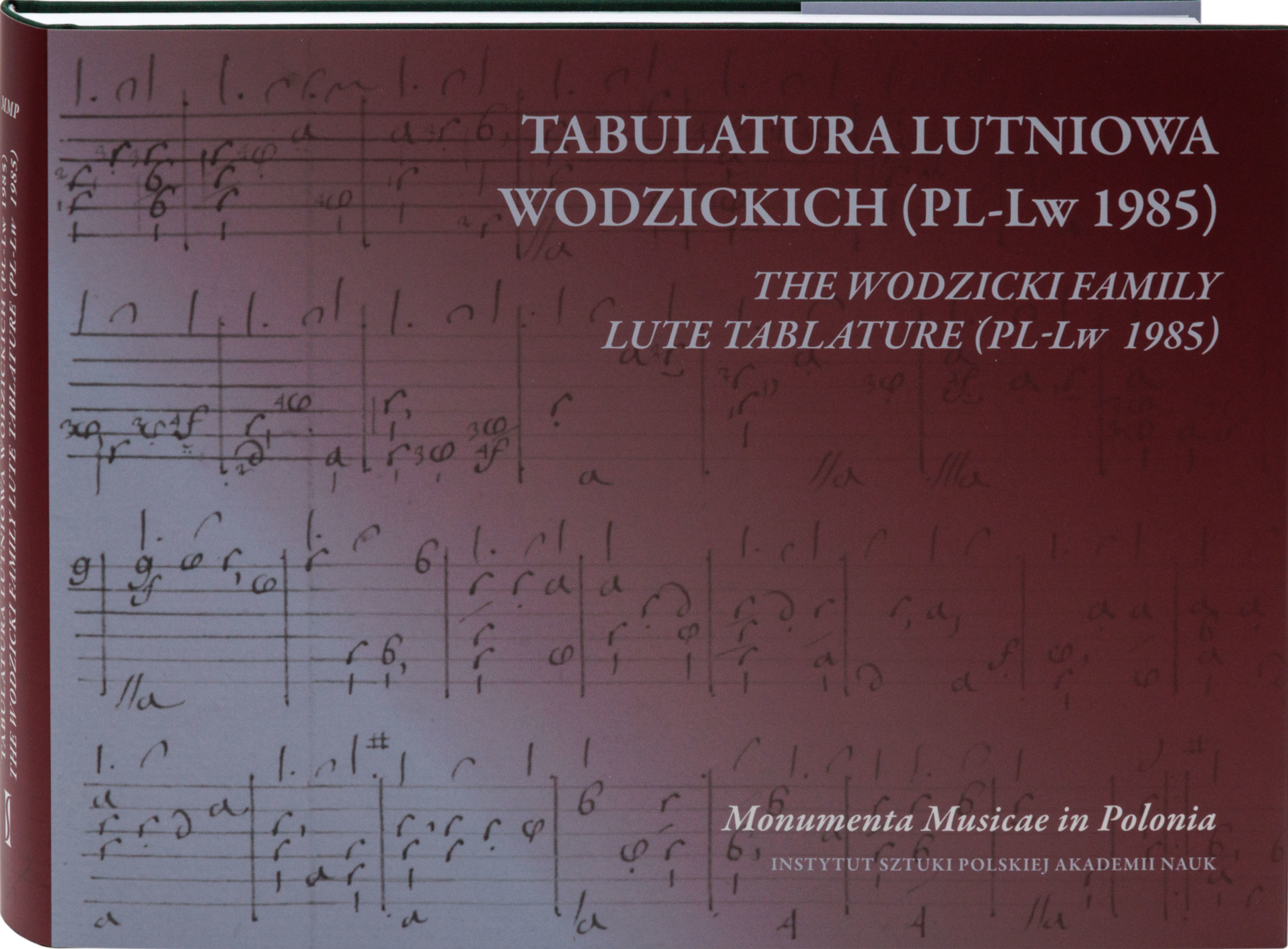
Tabulatura Lutniowa Wodzickich (PL-Lw 1985): edycja faksymilowa i krytyczna
Grzegorz Joachimiak (wyd./ed.)
Tabulatura Lutniowa Wodzickich (PL-Lw 1985): edycja faksymilowa i krytyczna / The Wodzicki Family Lute Tablature (PL-Lw 1985): Facsimile and Critical Edition, wyd./ed. by Grzegorz Joachimiak, red./ed. Bartłomiej Gembicki (=Monumenta Musicae in Polonia, red. nacz. / editor in chief Barbara Przybyszewska-Jarmińska, seria / series B: Collectanea Musicae Artis), ss. 481
(PL)
Tabulatura lutniowa Wodzickich (sygn. PL-Lw 1985) jest jednym z najważniejszych zachowanych źródeł muzyki lutniowej związanych z kulturą Rzeczypospolitej Obojga Narodów w drugiej połowie XVII wieku. Rękopis, przechowywany obecnie w Wojewódzkiej Bibliotece Publicznej im. Hieronima Łopacińskiego w Lublinie, zawiera 141 kompozycji świeckich, reprezentujących przede wszystkim francuski repertuar lutniowy epoki baroku. Jego związki z rodziną Wodzickich z Kościelnik pod Krakowem oraz środowiskami muzycznymi Francji i Włoch czynią go wyjątkowym świadectwem międzynarodowych kontaktów muzycznych i recepcji kultury francuskiej w Rzeczypospolitej w czasach panowania króla Jana III Sobieskiego.
Wśród utworów znajdują się kompozycje najwybitniejszych francuskich lutnistów XVII wieku, m.in. Denisa i Ennemonda Gaultierów, Charles’a Moutona, Jacques’a Gallota i Germaina Pinela, a także opracowania fragmentów oper i baletów Jeana-Baptiste’a Lully’ego oraz utwory anonimowe, w tym kompozycje o polskich konotacjach. Badania porównawcze repertuaru pozwoliły na weryfikację dotychczasowych atrybucji, identyfikację licznych konkordancji oraz dokładniejsze rozpoznanie dróg rozpowszechniania muzyki lutniowej w Europie końca XVII wieku.
Publikacja ta jest pierwszą kompletną edycją faksymilową i krytyczną rękopisu. Obejmuje wstęp monograficzny poświęcony historii i proweniencji źródła, jego strukturze kodykologicznej, identyfikacji skryptorów, repertuarowi oraz specyfice francuskiej notacji lutniowej. Szczególnym elementem opracowania jest koncepcja edytorska, polegająca na bezpośrednim zestawieniu reprodukcji każdej strony rękopisu z odpowiadającą jej transkrypcją na współczesną notację pięcioliniową, zachowującą układ i długość poszczególnych liniatur oryginału. Takie rozwiązanie umożliwia zarówno pogłębione badania nad historyczną praktyką wykonawczą, jak i krytyczną analizę struktury muzycznej utworów, z uwzględnieniem różnic między zapisem źródłowym a jego współczesną interpretacją edytorską.
Tom zawiera ponadto wstęp edytorski, ilustracje, komentarz krytyczny obejmujący atrybucje, konkordancje, warianty i korekty zapisu, a także aneks z rekonstrukcjami czterech niekompletnie zachowanych utworów. Publikacja została przygotowana w wersji dwujęzycznej, polskiej i angielskiej.
(ENG)
The Wodzicki Family Lute Tablature (shelfmark: PL-Lw 1985) is one of the most important surviving sources of lute music associated with the musical culture of the Polish-Lithuanian Commonwealth in the second half of the seventeenth century. The manuscript, currently held at the Hieronim Łopaciński Provincial Public Library in Lublin [Wojewódzka Biblioteka Publiczna im. Hieronima Łopacińskiego w Lublinie], contains 141 secular compositions, representing predominantly the French lute repertoire of the Baroque period. Its connections with the Wodzicki family of Kościelniki near Kraków, as well as with musical circles in France and Italy, make it an exceptional testimony to international musical contacts and the reception of French musical culture in the Polish-Lithuanian Commonwealth during the reign of King John III Sobieski.
The manuscript includes works by some of the most prominent French lutenists of the seventeenth century, including Denis and Ennemond Gaultier, Charles Mouton, Jacques Gallot, and Germain Pinel, as well as arrangements of excerpts from operas and ballets by Jean-Baptiste Lully and anonymous compositions, including pieces with Polish connotations. Comparative research into the repertoire has enabled the reassessment of previous attributions, the identification of numerous concordances, and a more precise understanding of the transmission of lute music across Europe in the late seventeenth century.
This publication is the first complete facsimile and critical edition of the manuscript. It includes a monographic introduction devoted to the history and provenance of the source, its codicological structure, the identification of its scribes, its repertoire, and the characteristics of French lute tablature notation. A distinctive feature of the edition is its editorial approach, which places a facsimile of each manuscript page directly opposite the corresponding transcription into modern staff notation, preserving the layout and length of the individual systems of the original tablature. This arrangement facilitates both in-depth research into historical performance practice and critical analysis of the musical structure of the compositions, while allowing for the distinction between the original notation and its modern editorial interpretation.
The volume also includes an editorial introduction, illustrations, a critical commentary covering attributions, concordances, variants, and corrections to the musical text, as well as an appendix containing reconstructions of four incompletely preserved compositions. The publication is bilingual, with texts in Polish and English.


