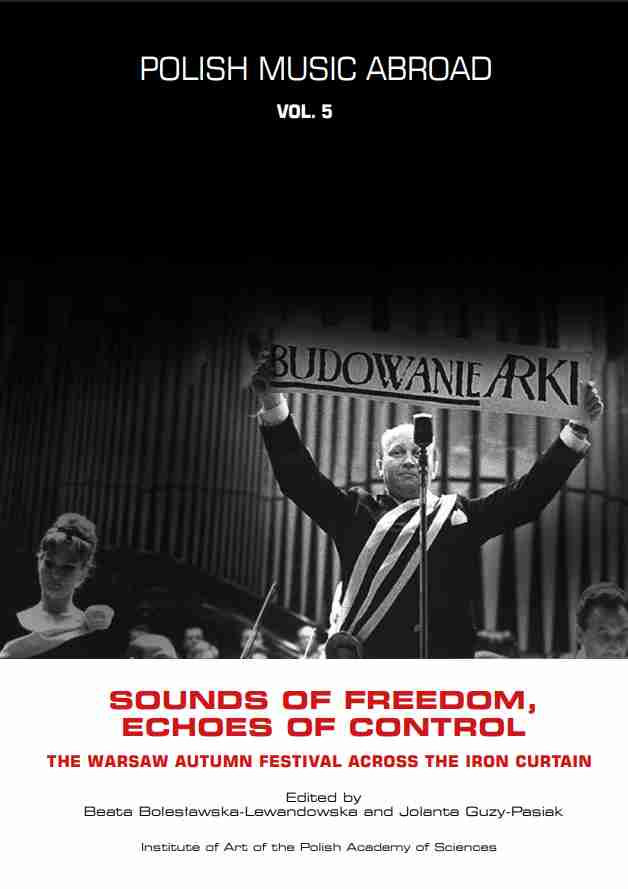
Muzyka polska za granicą, t. 5: Sounds of Freedom, Echoes of Control: The Warsaw Autumn Festival across the Iron Curtain
Beata Bolesławska-Lewandowska, Jolanta Guzy-Pasiak (Eds.)
Instytut Sztuki PAN, 2025
Warsaw Autumn Festival and Its Legacy: An Introduction
The establishment of the Warsaw Autumn festival gave birth to a new situation in Polish music. Hence, the date 1956, remains crucial not only in Polish 20th-century political history, but also in the history of Polish music: it marks the beginning of contemporary era in Polish musical culture. The success of the Warsaw Autumn opened up possibilities for contacts with Western musical culture, which resulted in breaking the cultural isolation of the previous years. Thanks to the Warsaw Autumn Poland renewed its participation in European cultural life, while a knowledge of the most recent musical trends allowed Polish composers to change their musical languages and develop most innovative musical ideas, which soon resulted in the appearance of new Polish music on the international scene.8 In next years, the Warsaw Autumn became not only a symbol of the new state of freedom in art in Poland, but also served as the most important platform for exchange of contemporary music from the both sides of the Iron Curtain.
Front cover photo: Barbara Krafftówna, Zbigniew Kryński, and Andrzej Szczepkowski performing Igor Stravinsky’s The Flood on September 21, 1965. Photo by Andrzej Zborski. Warsaw Autumn/Polish Composers’ Union Archive
Book Reviews (fragments)
This book examines the history of one of the most important contemporary music festivals – the Warsaw Autumn Festival which started in 1956. The essays collected here were written by musicologists from a number of academic centres around the world, and introduce groundbreaking changes to the existing state of research, presenting new valuable source material and facts about composers from many different countries who were influenced by the Warsaw festival.Thanks to the international perspective offered by the volume, it was possible to discover previously unknown facts and affiliations between Polish musicians involved in the Warsaw Autumn Festival and circles of musicians and composers abroad. Throughout its history, the Festival forged an international community of artists devoted to freedom of expression in defiance of totalitarian control.
Prof. Katarzyna Naliwajek, University of Warsaw
The fairly widespread belief in the unique role of the Warsaw Autumn as a ‘window to the world’ for composers from Eastern Bloc countries and a place for dialogue between attitudes and aesthetics from both sides of the Iron Curtain has been strongly legitimised in the texts included in the book. The scope of influence of the achievements of the Polish school of composition, which began to function on the international stage thanks to the festival, is astonishing: the inspiring impulse reached not only neighbouring countries, contributing to the emergence of new Slovak and Ukrainian music, but also crossed the borders of Europe and found fertile ground in the work of Brazilian composers.
Prof. Ewa Wójtowicz, Krzysztof Penderecki Academy of Music in Kraków