

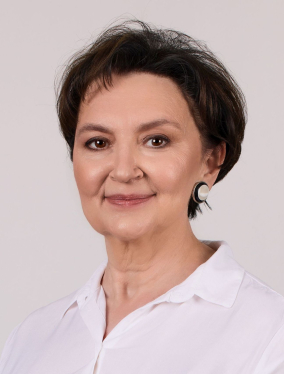
Ewa Dahlig-Turek, Associate Professor
Director of the Institute of Art, Polish Academy of Sciences
Ethnomusicologist and a graduate of the Institute of Musicology at the University of Warsaw, as well as of the postgraduate management studies at the Warsaw School of Economics. Her research focuses on traditional musical culture in Poland, particularly the history of stringed chordophones and the morphology of 'Polish rhythms' in Polish and Scandinavian traditional music. Following an internship at the University of Essen (1992/1993), she began using and developing Music Information Retrieval methods, i.e. computerised research on musical notation. Since 1994, she has continuously run the EsAC (Essener Assoziativ Code) project, developing databases used by many foreign research centres.
She is an expert for the Australian Research Council, the Israel Science Foundation, the European Science Foundation, the Foundation for Polish Science and Ministry of Science programmes and teams. She is also a member of the International Council for Traditional Music and the European Seminar in Ethnomusicology.
Since 2003, she has been a member of the Academic Board of the Institute of Art of the Polish Academy of Sciences. In 2014, she was awarded the Gloria Artis Silver Medal.
Publications
Ewa Dahlig-Turek, Ethnomusicology and Studies of the Dance Element in Music of the First Half of the Nineteenth Century, w: The Element of Dance in Music of the First Half of the Nineteenth Century, red. Grzegorz Zieziula, Warszawa 2023, s. 205-225.
Ewa Dahlig-Turek, Knee-Fiddles in Poland: Multidimensional Bridging of Paradigms, w: Crossing Bridges: Music, Intergenerational Transmission and Transformation, red. Zuzana Jurková i David Verbuč. Prague 2016.
http://www.etnomuzikologie.eu/index.php/publikace [bez numeracji stron]
Ewa Dahlig-Turek, Maria Pomianowska, Polskie fidele kolanowe. (Re)Konstrukcja. Teka lubelska t. 4, Lublin–Kraków–Warszawa 2014.
https://polona.pl/item/126017283; https://academica.edu.pl/reading/readSingle?cid=126018535&uid=126017283
Ewa Dahlig-Turek, Chopin and Polish FOLK, “Interdisciplinary Studies in Musicology”, 2011, t. 9, s. 343-355.
Ewa Dahlig-Turek, From Jan of Lublin to Chopin’s Mazurkas. A brief history of ‘Polish rhythms’, w: The Sources of Chopin’s Creative Style: Inspirations and Contexts, red. Artur Szklener, Warszawa 2010, s. 17-49.
Ewa Dahlig-Turek, Studying Rhythm Morphology, “Lietuvos Muzikologija”, 2009, nr 10, s. 127-137.
Ewa Dahlig-Turek, „Rytmy polskie” w muzyce XVI-XIX wieku. Studium morfologiczne,Warszawa 2006.
https://polona.pl/item/rytmy-polskie-w-muzyce-xvi-xix-wieku-studium-morfologiczne,MTMxOTQ5MTg0/12/#info:metadata
Ewa Dahlig-Turek, Bjørn Aksdal, Dan Lundberg, Rebecca Sager, Glossing over rhythmic style and musical identity, Stockholm 2005. https://carkiv.musikverk.se/www/epublikationer/Meddelanden_fran_Svenskt_visarkiv_47_for_web.pdf
Ewa Dahlig-Turek, Rhythms of Swedish polskas and their relation to Polish Folk Dances, w: The Polish Dance in Scandinavia and Poland. Ethnomusicological Studies. “Skrifter utgivna av Svenskt visarkiv” 17, red. Märta Ramsten, Stockholm 2003, s. 155-164.
Ewa Dahlig-Turek, Ludowe instrumenty skrzypcowe w Polsce, Warszawa 2001, s. 220.
https://academica.edu.pl/reading/readSingle?cid=132551130&uid=131949182&fbclid=IwAR3tONVDLFTqfFgKuA0oiRP_Zx8st7hkVzAh60ANth97zM3-kK0eDC9n4bE
Ewa Dahlig-Turek, EsAC. An Integrated System of Encoding, Analysing and Processing of One-part Melodies w: Musik und Neue Technologie, Band 3. Musik im virtuellen Raum, red. Bernd Enders i Joachim Stange-Elbe, Osnabrück 2000, s. 427-433.
Ewa Dahlig-Turek, Helmut Schaffrath, Judgments of Human and Machine Authorship in Real and Artificial Folksongs, w: Computing in Musicology 11, Melodic Similarity. Concepts, Procedures, and Applications, red. Walter B. Hewlett, Eleanor Selfridge-Field, Cambridge, London 1998, s. 211-219.
Ewa Dahlig-Turek, A Sixteenth-Century Polish Folk Fiddle from Płock, “The Galpin Society Journal” 47, s. 111-122.
Ewa Dahlig-Turek, Monophonie, hétérophonie et poly(?)phonie dans le jeu du violon traditionnel en Pologne, “Cahiers de Musiques Traditionnelles”, 1993 nr 6, s. 45-53.
https://ethnomusicologie.revues.org/1386
Ewa Dahlig-Turek, Ludowa gra skrzypcowa w Kieleckiem, Kraków 1990.
http://sbc.wbp.kielce.pl/dlibra/publication/48194/edition/47567/content
Projects
Projekty krajowe:
2015-2023 NPRH: Opracowanie zapisów muzycznych z Dzieł Wszystkich Oskara Kolberga w trybie Music Information Retrieval i ich udostępnienie do badań naukowych; kierownik projektu.
2012-2014 NPRH: Opracowanie naukowe i udostępnienie do badań etnomuzykologicznych najstarszych źródeł fonograficznych ze Zbiorów Fonograficznych Instytutu Sztuki PAN; kierownik projektu.
1999-2001 KBN: Mazurek w polskiej i europejskiej tradycji muzycznej; kierownik projektu.
Projekty międzynarodowe:
2009-2011 EuropeanaConnect, współfinansowany przez Komisję Europejską; koordynator zespołu polskiego.
2006-2008 DISMARC-DIScovering Music ARChives; współfinansowany przez Komisję Europejską projekt sieciowania europejskich archiwów muzycznych; koordynator zespołu polskiego.
2005-2006 Connecting Memories: Historical Sound Documents as Acoustic Images of the Own and the Other; program Socrates –Grundtvig; wykonawca.
2003-2005 Glossing over rhythmic style and musical identity; projekt badawczy nie finansowany, zakończony publikacją. Współpracownicy: Bjoern Aksdal (Norges Teknisk-Naturvitenskapelige Universitet, Trondheim), Dan Lundberg (Svenskt Visarkiv, Stockholm), Rebecca Sager (USA).
Projekty infrastrukturalne:
2021-2023 Cyfrowa infrastruktura badawcza dla humanistyki i nauk o sztuce DARIAH-PL, POIR; członek komitetu sterującego.
2009-2011 Budowa Centrum Archiwizacji i Digitalizacji Materiałów Foto- i Fonograficznych CADIS (Centre for Archivisation and Digitisation of Image and Sound); POIG; kierownik projektu.