

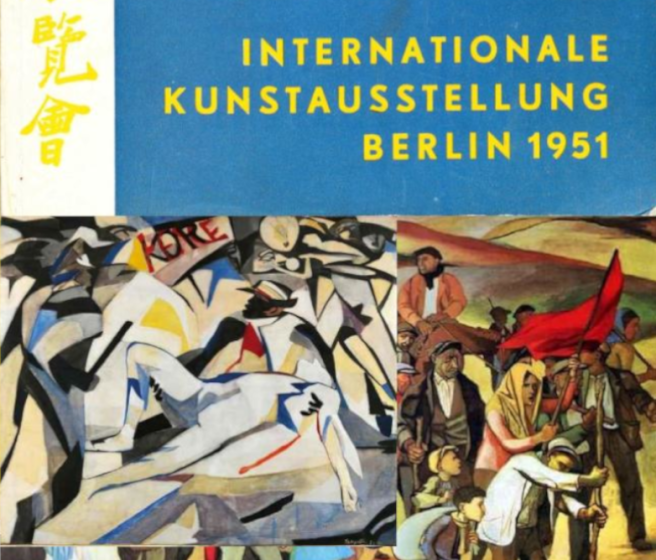
Pracownia Dokumentacji Sztuk Wizualnych XX i XXI wieku oraz dr Karolina Labowicz-Dymanus zapraszają we wtorek 28 stycznia o godzinie 18:00 na Seminarium online Sztuka po 1954 roku - nowe badania, nowa metodologia. Spotkanie odbędzie się wokół najnowszych badań Laury Rosengarten (Uniwersytet w Lipsku): Across the “Iron Curtain” in the early fifties The Italian left and the Internationale Kunstausstellung 1951 in East-Berlin.
Spotkanie w języku angielskim.
The Department of 20th and 21st Century Visual Arts Documentation and dr Karolina Łabowicz-Dymanus invite You to an online seminar on Tuesday, January 28, at 6:00 PM: “Art After 1945 – New Research, New Methodologies". The meeting will focus on the latest research by Laura Rosengarten (University of Leipzig): Across the ‘Iron Curtain’ in the Early Fifties: The Italian Left and the Internationale Kunstausstellung 1951 in East Berlin.”
Zoom: https://us06web.zoom.us/j/8483078653?pwd=PCaRmb7pMb9yXup7fCu7ezRtoHxKeF…
Meeting ID: 848 307 8653
Passcode: 021661
Across the ‘Iron Curtain’ in the Early Fifties: The Italian Left and the Internationale Kunstausstellung 1951 in East Berlin
In 1951 East-Berlin held the III. World Festival of Youth and Students with sports, political and cultural mass events. Alongside with theater performances, concerts and film screenings the festival comprised more than ten venues for fine arts. The main art exhibition was the Internationale Kunstausstellung. It was held in the Academy of the Arts, and included art works from 32 countries (including the US, Romania, Poland and Chile). Still soviet art was the official role model, since it got a special venue in the ministry of finance and an extra exhibition catalog. The second largest contribution came however from the Italian left. Apart from bare numbers, it is remarkable that many of the Italian artworks did not fall into one with Socialist Realism in terms of style, but showed individual handwriting.
Another interesting aspect concerning the exhibition comes into play, if we look at the prehistory of the Italian contribution and the government's role. Only a few months before the Internationale Kunstausstellung was held, an art exhibition organized by the Italian communist daily l’Unità in Rome had been officially forbidden two times. Eventually some of the artworks that should have been on display in Italy, would be part of the show in East-Berlin a few months later. The example of the Italian left tells us about the ambiguities of the “Iron Curtain”, the role that art played in the early years of the “Cold War” and during the World Festival in 1951.
Laura Rosengarten is a Leipzig based art historian and curator, curatorial assistant at the Lindenau-Museum Altenburg (2018–2020), PhD candidate at the University of Leipzig (since 2021), scholarships by DAAD and Rosa-Luxemburg-Stiftung, scientific assistant at Leipzig University Library (since 2022). Her PhD project examines the art relations between the GDR, Italy and France within the first decade after 1945. Current publication: Renato Guttusos Occupazione delle terre incolte in Sicilia in der DDR, in: Tübke und Italien (2024).
Pracownia Dokumentacji Sztuk Wizualnych XX i XXI wieku oraz dr Karolina Labowicz-Dymanus zapraszają we wtorek 28 stycznia o godzinie 18:00 na Seminarium online Sztuka po 1954 roku - nowe badania, nowa metodologia. Spotkanie odbędzie się wokół najnowszych badań Laury Rosengarten (Uniwersytet w Lipsku): Across the “Iron Curtain” in the early fifties The Italian left and the Internationale Kunstausstellung 1951 in East-Berlin.